
They told us the digital economy would end inflation.
With software eating the world, automation scaling faster than hiring, and cloud services replacing legacy infrastructure, the promise was simple: technology would make everything cheaper. But the data tells a different story.
From 2021 to 2023, inflation in the United States spiked above 8%. Even after a correction, core service inflation still holds above 3.5% – well above the Fed’s 2% target. Despite widespread digitization, we didn’t see broad deflation. Why?
Because digitization ≠ automation. Most SaaS tools are layered on top of human labor, not replacing it. Only now, with AI copilots, autonomous agents, and synthetic workflows, we’re entering a phase where productivity truly scales.
So if AI can finally lower inflation, the real question is:
Where to invest in AI stocks that benefit as prices normalize?
Table of Contents
Can the Development of AI Services Reduce Inflation by Lowering the Cost of Services?
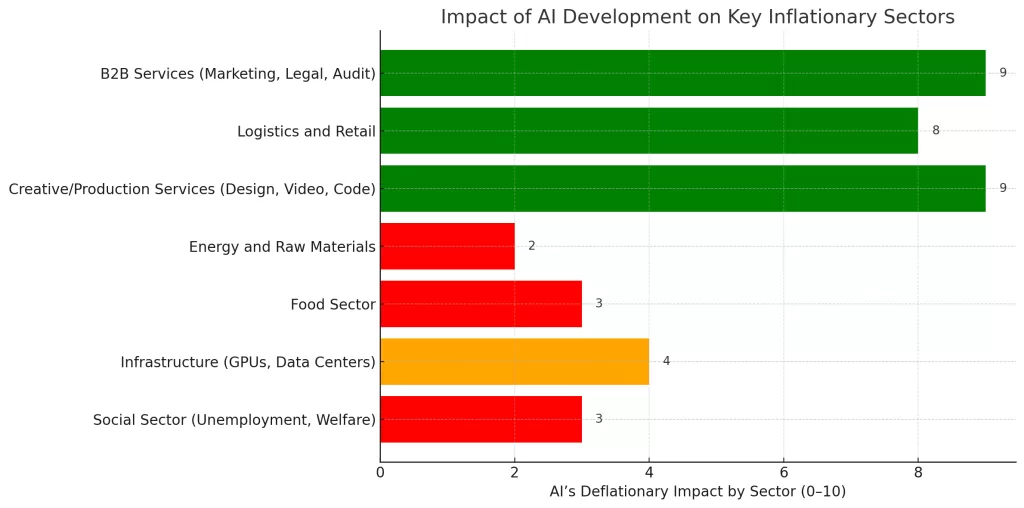
Yes, the development of AI services can reduce inflation, but indirectly and unevenly across sectors. Below is a breakdown with real-world examples.
HOW AI CAN REDUCE INFLATION
1. Lower operating costs = lower end prices
AI automates routine processes, reducing the need for human labor and associated expenses (salaries, taxes, errors, training).
Examples:
- Instead of a team of five marketers, one person can manage campaigns using AI tools like Jasper, ChatGPT, or Surfer SEO.
- AI designers (Midjourney, DALL·E) cut costs on banners, packaging, and animations.
➡ This can reduce B2B and B2C service prices.
2. Increased productivity
AI increases output per unit of cost.
Example: In the legal sector, AI already helps process cases 60–70% faster (Goldman Sachs, 2023).
➡ This lowers the cost of premium services like legal, financial, or accounting support.
3. Pricing and logistics optimization
AI helps optimize logistics, procurement, and pricing in retail and manufacturing.
Example: Amazon and Walmart use AI to manage inventory and discounts, reducing overhead and avoiding shortages that often drive price increases.
WHY AI CAN’T BE THE ONLY TOOL AGAINST INFLATION
1. Raw materials, energy, and food are outside AI’s influence
Even with full automation, prices of oil, gas, wheat, and metals are driven by global markets and geopolitics.
2. AI demand can drive inflation elsewhere
AI infrastructure (GPUs, data centers, energy) is expensive.
Example: In 2024, Nvidia’s H100 GPU cost over $30,000, inflating prices for computing hardware and server capacity.
3. AI could increase unemployment → higher social spending
If AI displaces large numbers of workers, it may cause social tension and require more government support, which in turn fuels inflationary pressure.
Where AI Is Reducing Inflation:
B2B Services (Marketing, Audit, Legal)
AI is already replacing expensive manual labor → services become cheaper → pricing pressure decreases.
Logistics and Retail
AI improves demand forecasting, inventory control, and route optimization → fewer losses and disruptions → prices stay more stable.
Creative and Production Services (Design, Video, Code)
Generative AI tools (like Midjourney, GPT, GitHub Copilot) reduce the cost of creating assets and MVPs → lowers entry barriers and final product prices.
Where AI Does Not Solve Inflation Yet:
Energy and Raw Materials
AI can’t control oil, gas, or metal prices — these are driven by geopolitics and speculation.
Food Sector
AI supports agro-analytics, but it can’t fix droughts, wars, or disrupted supply chains. Food won’t get radically cheaper from AI alone.
Infrastructure (GPUs, Data Centers)
AI demand increases hardware and cloud loads → rising costs of chips and compute may cause inflation in the tech sector itself.
Social Sector
AI may displace jobs → higher unemployment → pressure on government budgets → potentially inflationary due to increased public spending.
1. Sectors Where AI Reduces Costs and Boosts Profitability
✅ Invest in companies that use AI to optimize operations, not just talk about it.
| Sector | Why It’s Promising | Example Companies / Niches |
|---|---|---|
| B2B SaaS | AI automates data handling, marketing, and sales. High profit margins. | HubSpot, Notion, Jasper |
| AI-Optimized Logistics | Increases efficiency, reduces waste and costs. | Amazon, Flexport, GXO Logistics |
| EdTech / LegalTech / HealthTech | Automates complex services — fewer employees, higher margins. | DoNotPay, Tempus, Duolingo |
| AI Infrastructure | These companies don’t create AI — they build tools for it (GPUs, APIs, LLMs). | Nvidia, TSMC, Snowflake, Fastly |
| AI Integrators / Outsourcing | Enterprises need AI implementation → rising demand for consulting and dev work. | EPAM, Globant, Accenture |
⚠️ 2. Avoid Companies Where AI Doesn’t Cut Structural Costs
- Energy sector: AI doesn’t solve the problem of expensive oil and gas.
- Agribusiness: AI helps, but can’t prevent droughts or supply chain breakdowns.
- Speculative AI projects without viable business models: high hype, no substance.
🧠 3. Focus on Three Investment Scenarios
✅ Deflationary Value
AI lowers production costs → demand grows → company scales → stock or token gains value.
❌ The Illusion of Growth
Companies burn millions on AI without return (high burn rate, declining LTV/CAC) → short-term spike, long-term crash.
📊 Platform Winners
Infrastructure players (Nvidia, Snowflake, OpenAI integrators) win in nearly any AI demand scenario.
🪙 4. Where Else Should Investors Look?
- AI for investment automation (quant systems, robo-advisors).
- Deflationary crypto projects using AI to automate DeFi (e.g., AI market makers).
- AI agent platforms replacing full teams (e.g., Manus, Cognosys, Personal AI).
Conclusion:
AI will not eliminate inflation across the board, but it will redefine which sectors thrive as prices normalize. The winners will be companies that use AI to cut real costs, scale productivity, and streamline services, not just those riding the hype cycle.
For investors, the opportunity lies in AI infrastructure providers, automation-driven SaaS, and operationally efficient firms in logistics, legal, and B2B services. These are the players best positioned to profit from deflationary tailwinds without being exposed to inflationary bottlenecks like energy, food, or hardware scarcity.
In short: invest in utility, not narrative. AI will reduce inflation – selectively. Bet on companies that treat it as a tool for transformation, not a buzzword for valuation.