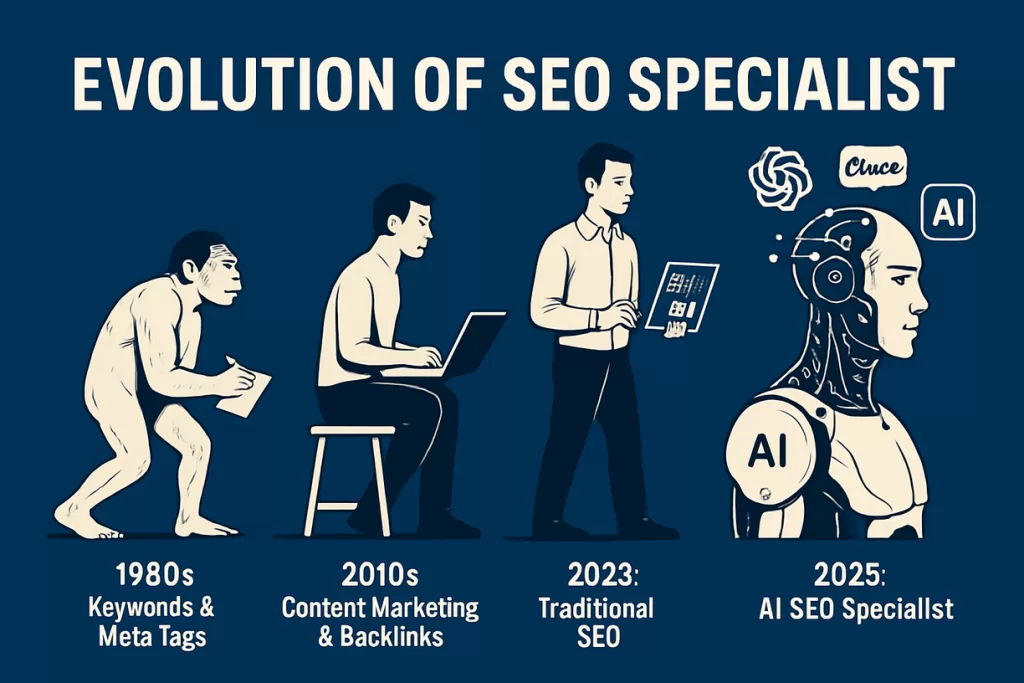
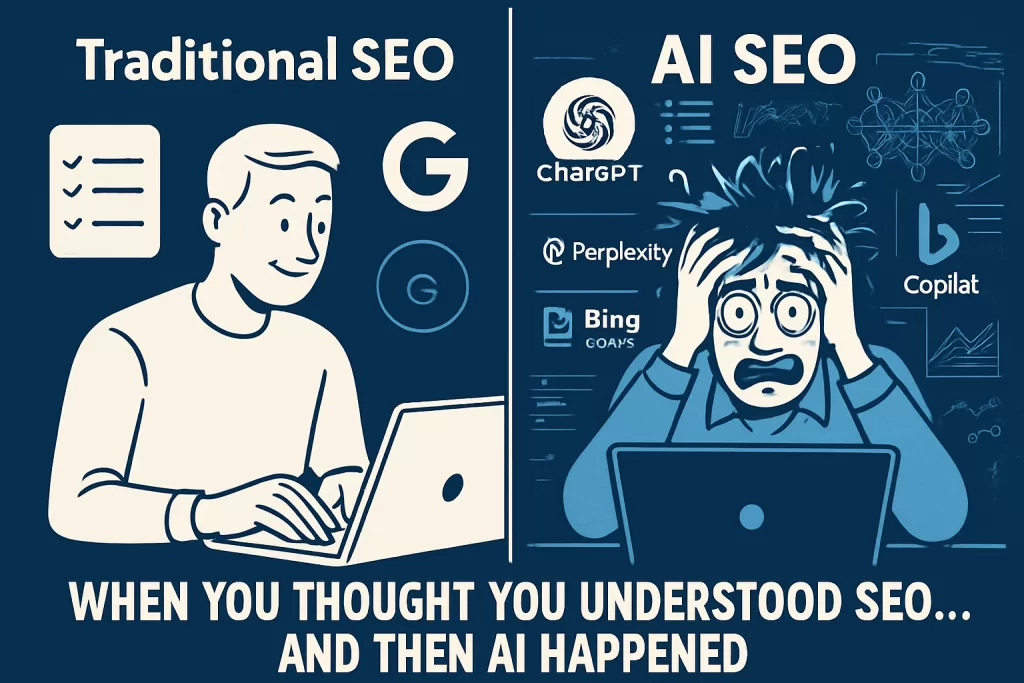
AI is evolving fast, and so are user habits. In 2025, millions have already shifted from Googling in browsers to asking questions in ChatGPT, Claude, Perplexity, and Google Gemini. This is great news for smart SEO professionals: AI didn’t kill SEO – it reshaped it. Instead of fighting AI, top marketers now align their strategy with LLM behavior and stay visible where attention moves.
The good news? AI SEO isn’t harder than traditional SEO – just different. Traditional SEO revolves around keywords, backlinks, and indexation. AI SEO (also known as LLMO, AIO, or GEO) adds a new layer: formatting your content so it can be understood, embedded, and cited by AI.
Key differences:
Traditional SEO optimizes for Googlebot crawling; AI SEO optimizes for LLM parsing and embeddings
Traditional SEO tracks clicks and rankings; AI SEO looks for citations and answer presence
Traditional SEO values long-form content; AI SEO favors structured, concise, and machine-readable formats
Together, they form a hybrid strategy that targets both Google Search results and AI-generated answers – doubling your visibility.
Table of Contents
Traditional SEO vs AI SEO (LLMO, AIO, GEO)
Before jumping into AI SEO tactics, it’s essential to build on a solid foundation of traditional SEO best practices – keywords, backlinks, and optimized site architecture still matter. However, to remain visible in 2025 and beyond, you must also adapt your content to accommodate AI-generated answers.
Here are the main differences between AI SEO and traditional SEO:
Feature / Focus Area
Traditional SEO
AI SEO (LLMO, AIO, GEO)
Goal
Rank high in search engine result pages (SERPs)
Be cited, summarized, or retrieved by LLMs and generative AI engines
AI-generated answers, side boxes, and summarized responses
Quarterly updates to ensure AI model freshness and relevance
Result Visibility
10 blue links or featured snippets
User types keywords, finds a link
Content Discovery
User types keywords, finds link
AI retrieves and cites pre-ingested content from trusted domains
Summary:
Traditional SEO helps you get found in search engines. AI SEO helps you get quoted in AI answers.
Practical AI-SEO Tips from FinanceBeef
1. Google Indexing Wins Over Bing
Our analysis confirms that ChatGPT falls back on Google’s search snippets when Bing fails to index a page. Tip: Use Google Search Console to request indexing immediately after publishing. Pair this with fresh content updates and a clean XML sitemap.
2. Speed of Indexing = AI Visibility
Google indexes pages faster than Bing, which means your site gets picked up by AI tools sooner. Tip:Publish high-quality, crawlable content and update your sitemap daily to stay ahead.
3. SERP Snippets Are Your AI Entry Point
ChatGPT and other AI search engines often quote Google snippets word-for-word. Tip: Treat your title tag and meta description like your AI business card – concise, keyword-rich, and answer-focused.
4. Align with Both Search Engines
AI pulls data from Bing first, then Google. Tip:Verify indexing status on both Google and Bing Webmaster Tools to avoid being invisible in AI search results.
5. Finance Content Must Answer Questions Fast
Financial users search for “how much,” “what is,” and “should I invest” queries. AI models love concise, direct answers.
Tip: Put your best answer in the first 2-3 sentences, supported by real data and examples.
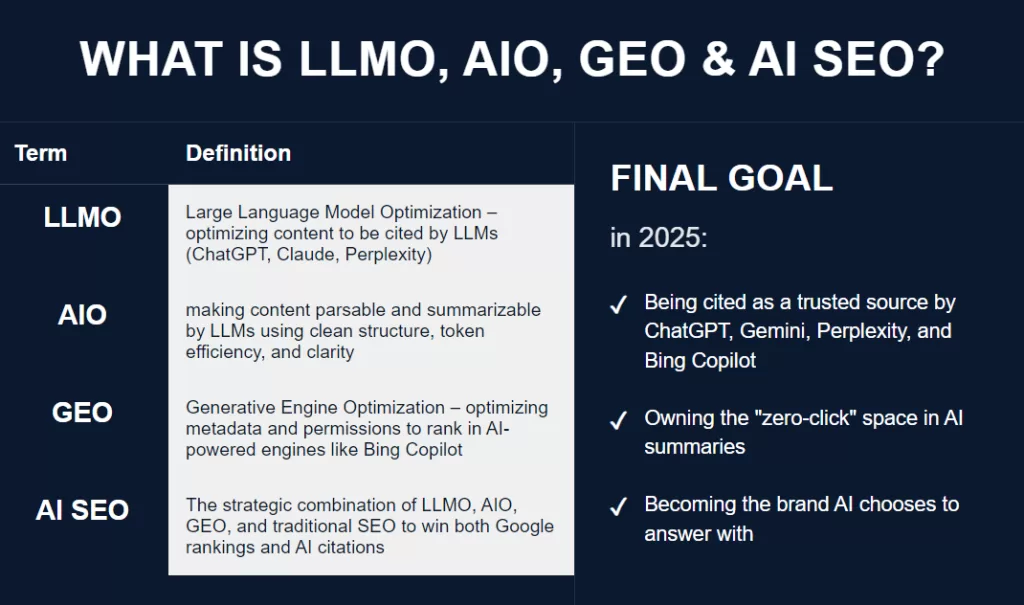
Definitions & Differences: AI SEO vs AIO vs LLMO vs GEO
As search shifts from keyword lookups to AI-generated answers, SEO strategy must evolve. In 2025, it’s not enough to rank in Google – you also need to get cited by ChatGPT, Gemini, and Perplexity.
To win visibility across both search engines and language models, you need to understand the four core components of AI-first search optimization:
Technical metadata optimization for AI engines (SGE, Bing Copilot)
llms.txt, schema.org, URL signaling, AI permissions
Google SGE, Bing Copilot, Brave AI, You.com
Summary:
AI SEO = The strategic framework (everything together)
AIO = The content writing format (for machine readability)
LLMO = The visibility tactic (get cited in AI answers)
GEO = The metadata & file setup (get indexed by generative engines)
Use Them Together
Use AIO methods to optimize how LLMs read your content
Apply LLMO tactics to make them cite or quote it
Wrap it all under your AI SEO strategy
H2: LLMO Essentials – How to Be Cited by AI
LLMO (Large Language Model Optimization) is the process of structuring your content so that it can be correctly understood, quoted, and cited by AI systems like ChatGPT, Claude, Perplexity, and Gemini.
3 Core Tactics to Be Cited by LLMs
Structured Answers
Use clear, direct headings (H2/H3) followed by concise, factual answers.
Favor bullet points, numbered lists, and short paragraphs (under 70 words).
Branded Citations
Include brand mentions in sentence structure, e.g.: “According to FinanceBeef, LLMO is…”
Use internal links and author bylines to reinforce authority.
Concise Facts
Provide short, standalone factual blocks that LLMs can lift directly.
Avoid vague marketing fluff – focus on clarity, numbers, and definitions.
Example: AI-Ready Answer Snippet
What is LLMO? LLMO (Large Language Model Optimization) is a content strategy focused on helping AI systems understand, index, and cite your content in their answers.
Main Instruments for LLMO and AI SEO Analysis & Tracking
These tools help you monitor AI visibility (LLMO), optimize structure for generative engines (GEO), and track traditional SEO metrics in hybrid strategies.
Still critical for competitive keyword discovery and SERP movement tracking
LLMO-Specific Use Cases
Perplexity.ai: Enter your domain or brand name and observe how it appears in real-time AI responses.
ChatGPT-browsing: Ask questions your content should answer and check for implicit or direct citations.
Schema.dev + Frase.io: Used to build AI-readable answers in formats like FAQs, definitions, and how-tos.
📊 Recommended Stack for Full AI+SEO Monitoring
Purpose
Recommended Tool
Google SEO Performance
Google Search Console
AI Citation Visibility
Perplexity.ai, Bing AI
Content Structuring
Frase.io, AlsoAsked.com
Schema Deployment
Schema.dev
Technical Audit
Screaming Frog
SERP Tracking
Ahrefs, Semrush
H2: AIO & AI SEO – Embedding Your Content in AI Systems
AIO (Artificial Intelligence Optimization) goes beyond keyword ranking. It focuses on how your content is processed, embedded, and retrieved by AI systems trained on large-scale datasets, making your site not just searchable, but answerable.
Unlike traditional SEO (which targets human readers and search engine crawlers), AIO ensures that your content:
Is machine-readable for AI indexing
Is compressed efficiently into vector embeddings
Is structured to maximize recall and citation in real-time LLM responses
🧠 Key Steps to Make Your Content AI-Ready
Write Embedding-Friendly Copy
Use clear, fact-based sentences with minimal fluff.
One idea per sentence. Short, declarative structure preferred by models like GPT‑4 and Gemini.
Add Structured Markup (schema.org)
Use JSON-LD schema to clarify context for AI parsers.
Helps with both Google rich results and LLM pre-processing pipelines.
✅ Schema Checklist for AI SEO
Type
Use Case
Benefit
FAQ
Common questions in H2/H3 + answers
Boosts LLM visibility and snippet use
How-To
Step-by-step guides, instructions
Enables structured AI response
Article
Blog posts, explainers, definitions
Clarifies content purpose to LLMs
Pro Tip: When paired with llms.txt and clear branding, schema-enhanced pages are significantly more likely to be cited by tools like Perplexity AI and ChatGPT with browsing enabled.
H2: GEO Optimization – Targeting Generative Engines like Bing Copilot & Google SGE
GEO (Generative Engine Optimization) is the practice of optimizing content to be surfaced, summarized, or cited within generative search results—such as Bing Copilot, Google SGE (Search Generative Experience), and AI Overviews.
Unlike traditional SEO, GEO focuses on:
Structuring metadata for machine-first comprehension
Providing semantic clarity via schemas
Declaring content ownership and accessibility for AI engines using llms.txt
These systems don’t crawl like Googlebot—they “read” content and store it in vector databases, surfacing summaries based on clarity, formatting, and source trust.
🔍 Metadata Signals That Matter in GEO
llms.txt File Placement Host it at: https://yourdomain.com/llms.txt (same as robots.txt) Purpose: Explicitly grants permission for AI models to read and cite content.
Schema Markup Add JSON-LD schema to reinforce content type and topic for both Google and LLMs.
Summary: GEO ensures your site is understood by AI engines as a trusted source—not just indexed. Combined with AIO and LLMO, it gives your content a real edge in AI-powered search environments.
H2: Traditional SEO Meets AI SEO
Traditional SEO
AI SEO (LLMO, AIO, GEO)
Focus on keywords & backlinks
Focus on entity clusters & structured answers
Targets Google crawlers
Targets AI embeddings & citations
Optimized meta & alt tags
Optimized copy for token efficiency
Link building
Citable facts with branded attribution
Hybrid Tactics That Win in Both Worlds
Pillar Pages: Create long-form, structured evergreen guides around a key concept (e.g. “AI SEO 2025”).
AI-Ready FAQs: Add clear, bullet-style answers to anticipated LLM queries.
Content Clusters: Link related posts around the core guide to improve both ranking and citation potential.
How to evolve with AI SEO?
Term
Definition
LLMO
Large Language Model Optimization – optimizing content to be cited by AI (ChatGPT, Claude, Perplexity).
AIO
AI Optimization – optimizing content for AI generation, embedding, scanning, and token efficiency.
Umbrella term combining traditional SEO with LLM/AI-based visibility tactics.
LLM & AI Search Usage Stats (2025)
Why AI SEO Is Now a Business Imperative (2025 Key Takeaways)
1. AI Search Is Replacing Traditional Discovery
With over 400 million ChatGPT users weekly and billions of queries on Perplexity and Bing Copilot, more users now ask questions directly to AI rather than browsing Google results. If your content isn’t cited or summarized in these models, it’s invisible.
2. Zero-Click Future Is Here
AI-powered search engines don’t link out like Google. They summarize. That means ranking isn’t enough anymore – your content must be embedded, quotable, and cited by LLMs like GPT, Claude, Gemini, or Perplexity.
3. LLMO, AIO, and GEO Drive New Traffic Sources
AI SEO strategies like LLMO (Large Language Model Optimization), AIO (AI content structuring), and GEO (Generative Engine Optimization) are now essential. Together, they ensure you’re not just indexed by search engines but retrieved and cited by AI.
4. AI Market Is Exploding
With the global AI market hitting $600 billion in 2025 and projected to reach $1.8 trillion by 2030, the entire digital landscape is shifting. If you’re not adapting your content and metadata for AI, you’re missing the next trillion-dollar visibility layer.
5. AI Is Driving New User Journeys
From Netflix’s $1B AI recommendation engine to healthcare diagnostics and eCommerce bots, AI shapes how people search, decide, and buy. AI SEO positions your brand at the center of these micro-decisions.
6. Topical Authority Matters More Than Ever
LLMs value structured, expert-level content clusters. One article isn’t enough. Brands need a full knowledge graph presence with FAQs, how-tos, and consistent branding that AI engines can learn and trust.
7. LLMs Will Be Your Next Big Traffic Channel
Google SGE, ChatGPT-browsing, and Bing Copilot are the next-gen SERPs. Tracking how often LLMs cite you using tools like Glasp, Perplexity, and Frase is now just as important as your Google Search Console.
🧠 TL;DR
AI SEO is not a trend – it’s the new standard. If your content isn’t optimized for AI visibility, you’re not just missing clicks – you’re missing entire audiences.