
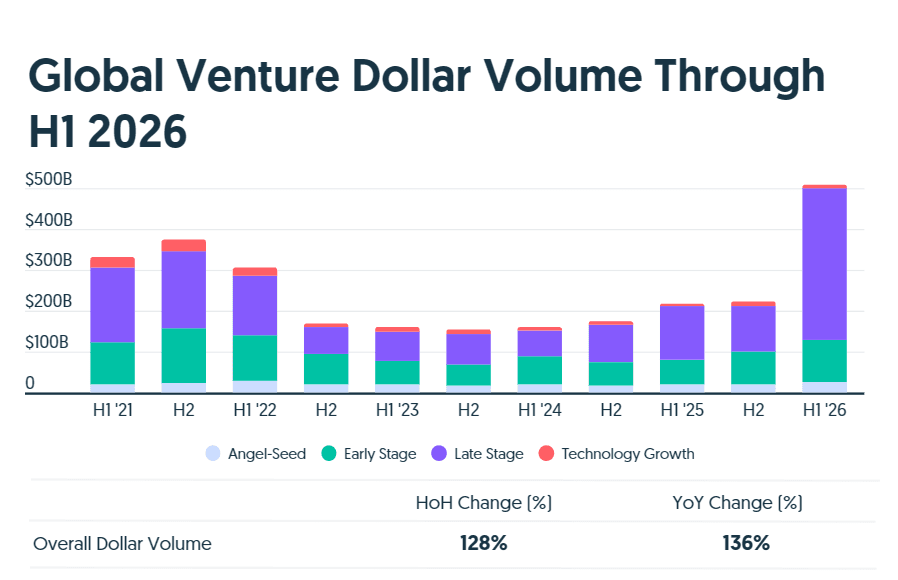
Global venture funding hit $510 billion in the first half of 2026. That is more than the $440 billion invested in all of 2025, and the highest half-year on record, according to Crunchbase.
Meanwhile, of the companies that raised a seed round in 2022, only about 17 percent reached a Series A within twenty four months. In a normal year, Carta puts that figure at 25 to 30 percent.
A record amount of money, and the hardest environment for early companies in years. Those two facts are not in tension. They are the same fact, seen from opposite ends of the market.
The money went to almost nobody
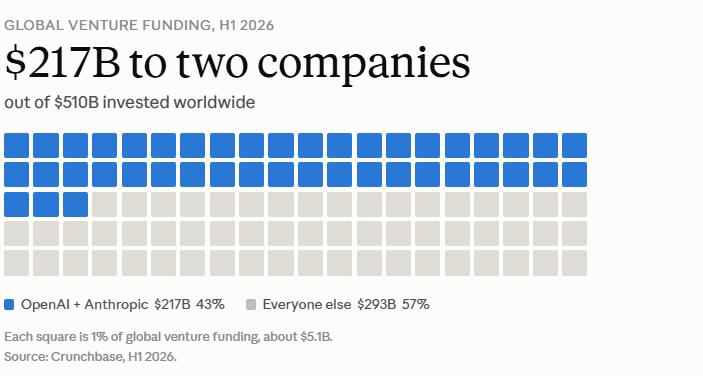
OpenAI and Anthropic together took $217 billion in the first half of 2026. That is 43 percent of all startup funding globally, for two companies. Anthropic alone raised $65 billion in the second quarter, close to a third of everything invested worldwide that quarter.
More than 70 percent of global startup capital in Q2 went to AI companies, up from just under 50 percent a year earlier.
The concentration is not only about which companies. It is about how few of them there are. PitchBook and the NVCA found that in 2025, half of all venture dollars went into 0.05 percent of deals.
Read that ratio again. One deal in two thousand absorbed half the capital.
This is not a funding boom. It is a concentration event that produces boom-shaped headlines.
Why AI specifically, and why now, is a longer story than a paragraph can carry. I went through it properly in a video where I traced how artificial intelligence moved from a research problem to the largest capital magnet in private markets. The investment case makes very little sense without that history, and most of the commentary skips it: watch here.
The seed market has split in two
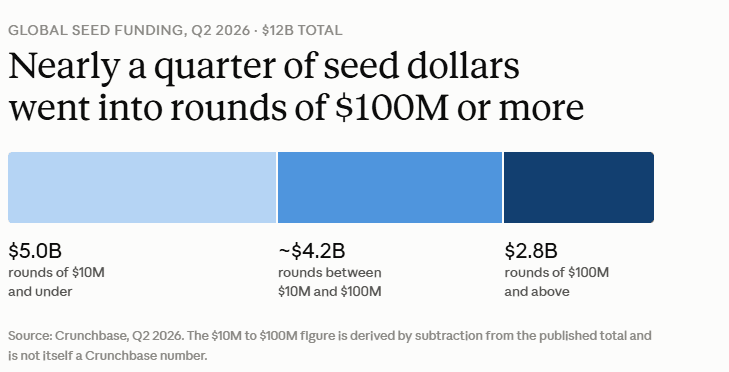
Crunchbase’s Q2 2026 data shows the split clearly. Global seed funding totaled $12 billion in the quarter. Of that, $2.8 billion went into seed rounds of $100 million and above, while $5 billion went into rounds of $10 million and under.
Seed rounds of a hundred million dollars did not exist as a category a few years ago. They now absorb a quarter of the seed market.
If you are a founder raising two million dollars, none of the record year was ever pointed at you. And if you are an investor being told that early stage capital is abundant, the abundance is happening in a part of the market you are almost certainly not in.
Why the money that is left behaves the way it does
The people who supply capital to venture funds have not been getting it back.
Net cash flows to limited partners have been almost $200 billion in the negative since the slowdown began in 2022. Nearly two hundred billion dollars more went in than came out.
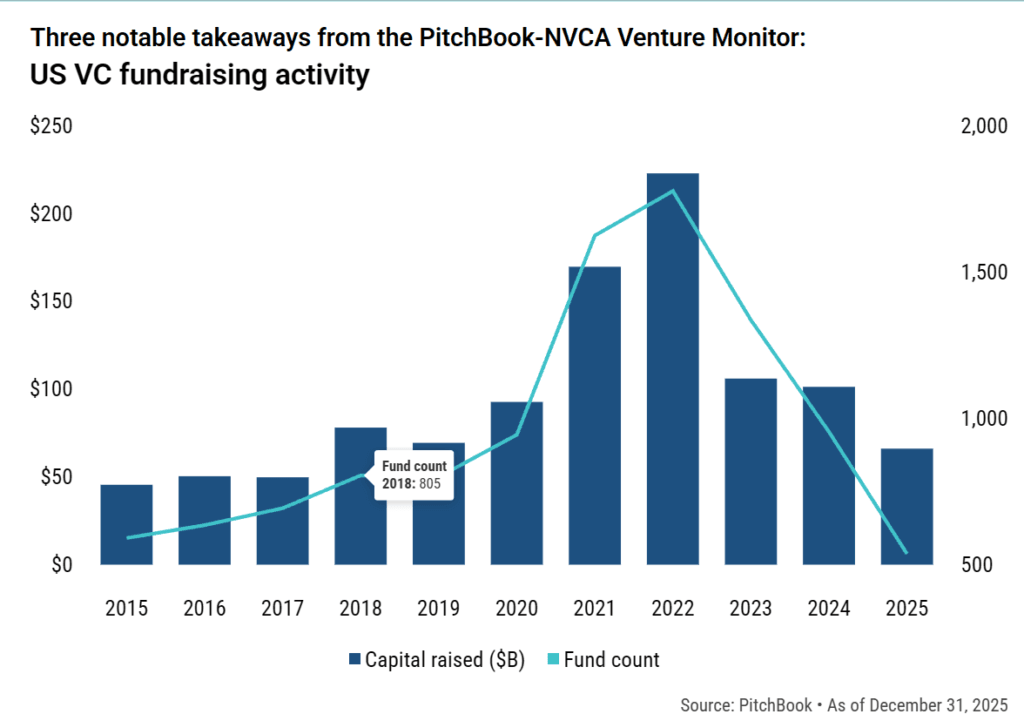
The consequence is arithmetic. US venture funds raised $66.1 billion across 537 funds in 2025, the lowest total since 2018. That fund count is 30 percent of the 2021 peak.
And even that shrunken pool is concentrated. Andreessen Horowitz closing $15 billion in January 2026 accounted for more than 18 percent of all new commitments to US venture funds since January 2025. One firm, nearly a fifth of the money.
Two more pressures sit on top. The aggregate value of US unicorns now stands at $4.3 trillion, sitting in private hands rather than returning cash through public markets. And borrowing got more expensive again: the ECB raised its three key rates by 25 basis points in June 2026, putting the deposit facility at 2.25 percent, the main refinancing rate at 2.40 percent and the marginal lending facility at 2.65 percent, effective 17 June.
The answer everybody reaches for

When capital stops arriving on its own, founders look for someone to help them become fundable. Accelerators, studios, business development firms. The pitch is roughly the same everywhere: we will do the work with you, and then the money will come.
This is where the data gets uncomfortable, and where I think investors should slow down.
A National Bureau of Economic Research working paper published in April 2026 studied roughly 750,000 US startups linked to 329 accelerators, using a value-added framework borrowed from education economics to separate what accelerators actually add from who they select. The finding, in the authors’ own words: most accelerators have negative value added relative to a no-accelerator benchmark, while a small right tail generates large gains.
Most. Negative.
The good programs are genuinely good. High value-added accelerators predict better acquisitions, employment, revenue and valuations, and they are also faster at shutting weak ventures down, which is its own kind of value. But the average program in that sample made companies worse off than doing nothing.
One honest note on that paper: one of its authors is the founding director of an accelerator, and the other is a postdoctoral researcher funded by it. Both disclose this in the paper. It does not weaken the result, and if anything an accelerator insider publishing “most accelerators subtract value” is the opposite of a self-serving finding. But you should know it, because I would want to know it.
The venture studio picture has a different problem. The most thorough independent count I could find, Big Venture Studio Research 2024, identified 1,107 studios established worldwide as of September 2024, of which 154 had already ceased operating. In the third quarter of 2024 there were 17 new studio registrations against 20 closures, which the authors note would make 2024 the first year with a net decrease in the number of venture studios.
So the model that gets described as exploding may have already peaked. The narrative is still growing. The count is not.
What this actually means for an investor
The story being sold right now is access. Get near the right program, the right syndicate, the right studio, and good deals will find you.
Access was scarce in 2015. It is not scarce now. What is scarce is a company where somebody actually did the unglamorous work: a number that falls out of a plan rather than out of what the market might give, an operational forecast sitting next to the financial one, demand that was measured rather than modeled, legal and maintenance costs that appear in the budget instead of arriving later.
The NBER result says something specific about this. It says selection is systematic, meaning better companies were already better before they applied. Programs are very good at picking. Most of them are not good at improving.
A logo on a deck tells you a company was selected. It does not tell you it was improved.
So the question worth asking is not which program a company went through. It is who did the operating work, and what they were paid to do it. There is a real difference between an operator who took equity and carries the same downside you do, and an intermediary paid a percentage for making an introduction. Both will describe themselves as involved. Only one of them loses money if the company does.
I run a full cycle business and product development company, so my bias here is obvious and I would rather state it than bury it. What I will say is that being inside a business changes what you can see. Costs, dependencies and operational problems that disappear entirely when a company is compressed into fifteen slides are simply visible when your own team is in the operating account. That does not remove risk. It gives me more to price it with.
That is also why I would rather introduce someone to a company I work with than forward an opportunity from one inbox to another. It is not a better business model. It is a narrower one, and the narrowness is the point.
Where this leads
Three things follow from the verified numbers, and only one is comfortable.
Companies that reach investors will be better prepared, because the filter has moved earlier and weak companies now fail faster and cheaper. That is bad for a founder and good for everyone who would otherwise have funded another eighteen months of it.
The support layer will consolidate. If most accelerators already subtract value and studio closures already outpace openings, the shakeout is not a forecast. It started.
And the exit math has changed underneath everything else. With $4.3 trillion of unicorn value sitting private and LP cash flows two hundred billion in the hole, an allocation made in 2026 should be priced for illiquidity that lasts, not for a listing that arrives.
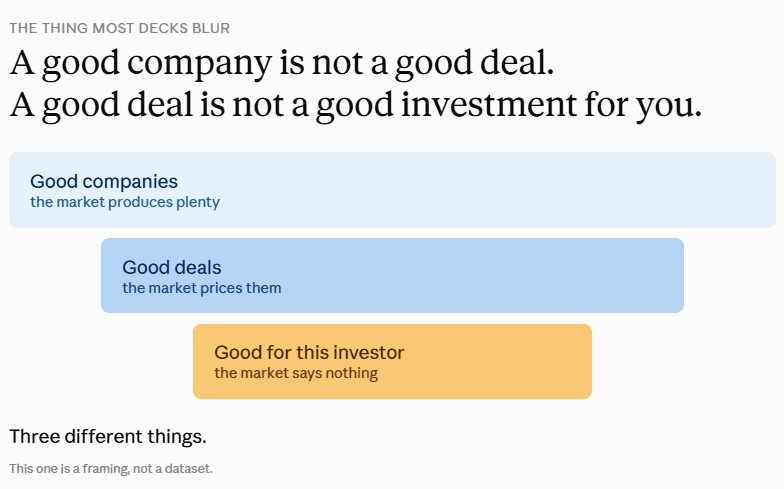
There are good companies. There are good deals. And there are good investments for a particular investor at a particular moment. The current market is very efficient at producing the first two and says almost nothing about the third.
On method
I have spent almost ten years around finance and investments and seven actively trading and investing myself. Securities brokerage in Europe and the US, crypto investment advisory, US real estate, Web3, private companies, and more than ten million dollars across capital raising, real estate, corporate and individual investments.
None of that makes the numbers above correct, so I checked them. Every figure here comes from the organization that produced it: Crunchbase, PitchBook and the NVCA, Carta, the European Central Bank, the NBER, and one independent venture studio census.
Five claims that circulated widely while I was writing did not survive. Angel syndicate growth figures traced back to a report I could not retrieve. Widely quoted venture studio performance numbers, including a 72 percent Series A conversion rate and average IRRs above 50 percent, come from the studio industry describing itself, with no independent verification. European Series A round sizes and a bank lending tightening figure traced to a single blog. And two statistics I had originally attributed to Carta turned out to be numbers Carta never published.
All five are documented, with sources and tiers, in the living reference I keep updated: Venture Data 2026: which numbers check out and which do not. If you find another figure that does not hold up, send it and I will add it.
I mention this not to be pedantic. If five out of seventeen widely repeated market statistics do not hold up, that failure rate is itself the most useful thing in this article.
What is the last number you were shown in a deck that you actually went and checked?
Venture Capital’s $1.9 Trillion Exit Record Was Mostly a Valuation, Not Cash — why the largest exit quarter on record was mostly a valuation rather than cash, and what that changes for allocating and raising.
The FinanceBeef Data Standard — the five rules and the seven-step check behind every number on this site. Copy the procedure.